How Is Child Pornography Prosecuted in Federal and State Courts?
March 27, 2026
Child pornography cases — often referred to in modern legal terminology as child sexual abuse material (CSAM) offenses — are prosecuted aggressively in both state and federal courts. These cases frequently involve digital evidence, forensic investigations, and multi-agency task forces.
If you or a loved one is under investigation, understanding how child pornography is prosecuted in federal and state courts is critical. The court system handling the case can significantly impact potential penalties, sentencing exposure, and defense strategy.
State Prosecution in Florida
In Florida, child pornography offenses are prosecuted under state criminal statutes. These cases are typically investigated by:
- Local police departments
- County sheriff's offices
- State cybercrime units
Common Florida State Charges
State prosecutors may file charges for:
- Possession of child pornography
- Distribution or transmission
- Promotion or possession with intent to distribute
- Use of a minor in a sexual performance
How State Cases Begin
A Florida state case may begin with:
- A cyber tip from the National Center for Missing and Exploited Children (NCMEC)
- A peer-to-peer file sharing investigation
- A search warrant executed at a home
- A digital device seizure
- A forensic examination of computers, phones, or cloud accounts
State charges are filed in circuit court within the county where the alleged offense occurred.
Federal Prosecution in the United States
Many child pornography cases are prosecuted federally because internet activity often crosses state lines. Even downloading or sharing files online can trigger federal jurisdiction.
Federal investigations typically involve:
- The FBI
- Homeland Security Investigations (HSI)
- Internet Crimes Against Children (ICAC) task forces
Federal charges are filed in U.S. District Court.
When Does a Case Go Federal?
A case may be prosecuted federally if it involves:
- Interstate or international transmission
- Large quantities of images
- Allegations of production
- Prior criminal history
- Organized file-sharing networks
- Aggravating factors (e.g., very young minors depicted)
Federal prosecutors often pursue harsher penalties and mandatory minimum sentences.
Key Differences Between State and Federal Prosecution
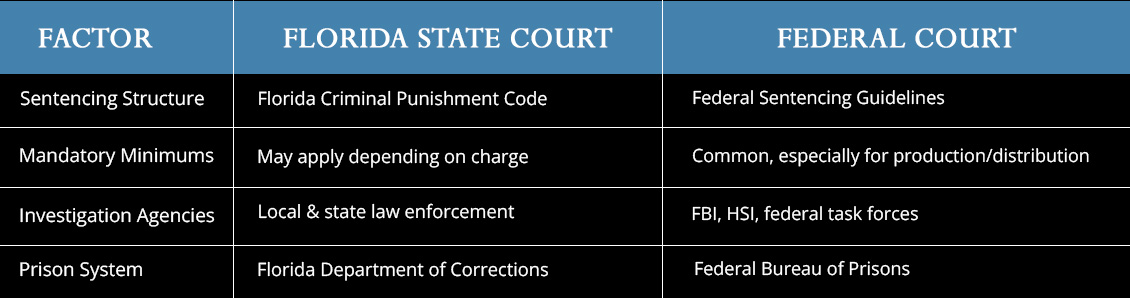
Federal sentencing guidelines frequently increase exposure based on:
- Number of images
- Use of a computer
- Age of the minor
- Sadistic or violent content
- Prior convictions
The Investigation Process
Both state and federal prosecutions typically involve:
- Cyber tip or online detection
- IP address tracing
- Subpoenas to internet service providers
- Search warrant execution
- Seizure of electronic devices
- Digital forensic analysis
- Arrest and formal charging
Digital forensic evidence plays a central role in these cases.
Potential Penalties in State and Federal Court
While exact penalties depend on the charge and circumstances, both systems impose severe consequences:
- Prison sentences (often multiple years)
- Mandatory sex offender registration
- Strict probation conditions
- Internet restrictions
- Fines and court costs
Federal cases often carry mandatory minimum prison terms, particularly for production and distribution offenses.
Defense Strategies in Child Pornography Cases
Every case is fact-specific. Potential defense approaches may involve:
- Challenging the validity of the search warrant
- Suppressing unlawfully obtained evidence
- Questioning forensic methodology
- Arguing lack of knowing possession
- Challenging IP address attribution
- Identifying constitutional violations
Because sentencing exposure can be substantial, early intervention by an experienced criminal defense attorney is critical.
Frequently Asked Questions (FAQ)
Can child pornography charges be both state and federal?
Yes. In some situations, both state and federal authorities may investigate. However, a case is usually prosecuted in one jurisdiction. Federal authorities may adopt the case if aggravating factors are present.
 Why are so many cases prosecuted federally?
Because internet transmission typically crosses state lines, federal jurisdiction is often triggered automatically.
Are federal penalties harsher than state penalties?
In many cases, yes. Federal law includes mandatory minimum sentences and sentencing guideline enhancements that can significantly increase prison time.
What is "knowing possession"?
To convict someone of possession, prosecutors generally must prove the person knowingly possessed or controlled the illegal material. Accidental downloads, malware, or shared device access can become contested issues.
How long do investigations take?
Investigations can take months or even years. Law enforcement often conducts lengthy forensic analysis before making an arrest.
Will I have to register as a sex offender?
A conviction in either state or federal court typically requires mandatory sex offender registration, often for life.
Can charges be reduced or dismissed?
That depends on the facts of the case, the strength of the evidence, and whether constitutional violations occurred. Early legal intervention can significantly affect the outcome.
DMT Information (Donet, McMillan & Trontz, P.A.)
If you are facing child pornography charges in Florida or federal court, you need a defense team that understands both systems.
Donet, McMillan & Trontz, P.A. (DMT) represents clients in complex state and federal criminal cases throughout Florida. The firm's attorneys have experience handling:
- Federal criminal investigations
- Digital forensic evidence disputes
- Pre-indictment representation
- Search warrant challenges
- Sentencing advocacy
Early representation can protect your rights, guide you through the investigation process, and help build a strategic defense from the outset.
Speak With a Criminal Defense Attorney Today
Child pornography cases are aggressively prosecuted and carry life-altering consequences. Whether your case is in Florida state court or federal court, the jurisdiction matters — and so does your defense strategy.
If you are under investigation or have been arrested, contact an experienced criminal defense attorney immediately to protect your rights and evaluate your legal options. You can reach out to us by calling
(305) 444-0030 or by asking for a free case consultation via our website's form.