Can a Dismissed Case Be Reopened? Understanding Florida Law
September 25, 2026
If your criminal case was dismissed, you may understandably believe that the matter is completely over. Sometimes it is—but a dismissal does not always prevent the State from bringing criminal charges again.

Whether a dismissed case can be reopened or refiled in Florida depends on several factors, including the reason for the dismissal, whether the dismissal was with or without prejudice, whether the State entered a nolle prosequi, whether jeopardy is attached, and whether the statute of limitations has expired.
For someone facing criminal charges, the difference can be significant. A case that appears to be finished could potentially be refiled under certain circumstances.
At Donet, McMillan & Trontz, P.A., we help clients understand what a dismissal actually means for their criminal case and what legal options may be available if the State attempts to bring charges again.
Important: "Dismissed" does not automatically mean "the State can never prosecute me again." The specific language and circumstances surrounding the dismissal matter.
What Does It Mean When a Criminal Case Is Dismissed?
A dismissal generally means that the criminal charge or case is no longer pending in its current form.
However, there are different ways a case can be dismissed, and they do not all have the same legal effect. For example, a case may be:
- Dismissed with prejudice
- Dismissed without prejudice
- Dismissed following a nolle prosequi
- Dismissed because of a speedy-trial violation
- Dismissed because of a legal or procedural defect
- Dismissed after the prosecution determines it cannot proceed
- Dismissed following another court ruling
The reason and wording of the dismissal can determine whether prosecutors have the ability to pursue the allegations again.
Can the State Refile Charges After a Dismissal in Florida?
Sometimes, yes.
A dismissal does not necessarily prevent prosecutors from filing the charges again.
For example, Florida appellate decisions recognize that when the State enters a nolle prosequi, the existing charging document is effectively terminated. If prosecutors later want to pursue the charge, they generally must formally charge the defendant again rather than simply "reopen" the old charging document.
In some circumstances, Florida courts have also recognized that the State may enter a nolle prosequi and later refile charges, provided doing so is legally permissible.
That means a person should not assume that a dismissed case can never come back.
What's the Difference Between Dismissed With Prejudice and Without Prejudice?
One of the most important questions is whether the dismissal was with prejudice or without prejudice.
Dismissed Without Prejudice
A dismissal without prejudice generally means that the State may have the ability to bring the charges again.
It does not necessarily mean that prosecutors automatically will—or that they can do so indefinitely.
The State may still have to comply with:
- The applicable statute of limitations
- Constitutional protections
- Speedy-trial requirements
- Double-jeopardy protections
- Court orders
- Procedural requirements
- Other restrictions applicable to the particular case
Florida's criminal statute of limitations establishes different time periods depending on the offense. For example, under the general provisions of Florida Statutes § 775.15, a first-degree felony generally has a four-year limitation period, other felonies generally have a three-year period, first-degree misdemeanors generally have a two-year period, and second-degree misdemeanors and noncriminal violations generally have a one-year period, subject to numerous exceptions.
Some serious offenses have substantially longer or no applicable limitation period under the statute.
Example
Suppose someone is charged with a crime and the case is dismissed without prejudice because the prosecution is not prepared to proceed.
That dismissal does not necessarily prevent the State from filing the charge again. But prosecutors must still determine whether refiling is legally permitted and whether the applicable time limitations have expired.
What Does a Dismissal With Prejudice Mean?
A dismissal with prejudice is generally much more significant for the defendant.
It means the case has been dismissed in a manner intended to prevent the State from simply bringing the same prosecution again.
However, even here, the exact circumstances matter.
A defendant should not assume that every document containing the word "dismissed" has the same legal effect. The actual court order, the reason for dismissal, the charges involved, and the procedural history should all be reviewed.
This is one reason obtaining a copy of the dismissal order and having a criminal defense attorney review it can be important.
What Is a Nolle Prosequi?
You may also hear the term "nolle prosequi," sometimes shortened to
"nol pros."
A nolle prosequi is a formal decision by the prosecution to stop pursuing a criminal charge.
Florida courts have explained that a nolle prosequi operates as a dismissal or nullification of the charging document. Once entered, the State cannot simply continue prosecuting the defendant under that same charging document; if the State wants to proceed again, it generally must formally file a new charging document.
Does a Nolle Prosequi Mean the Case Is Over Forever?
Not necessarily.
In certain circumstances, prosecutors may be able to refile the charges after entering a nolle prosequi.
Florida appellate authority has recognized circumstances in which the State entered a nolle prosequi and later refiled charges.
However, the State's ability to do so is not unlimited.
Issues such as the statute of limitations, speedy-trial protections, double jeopardy, and the circumstances surrounding the dismissal may affect whether a new prosecution is permissible.
Can a Case Be Reopened After the Statute of Limitations Expires?
Generally, prosecutors cannot simply wait indefinitely and then bring charges whenever they want.
Florida law establishes time limitations for criminal prosecutions, although numerous exceptions apply.
Under Florida Statutes § 775.15, certain serious offenses may be prosecuted at any time, while other offenses have specific limitation periods. The statute also contains exceptions and provisions affecting how the limitations period is calculated.
This makes the date of the alleged offense important.
It also means that determining whether a dismissed case can be refiled may require more than simply looking at the date the original case was dismissed. An attorney may need to examine:
- The date of the alleged offense
- The date the original charge was filed
- The date of dismissal
- The type of dismissal
- Whether the defendant was previously arrested or served with a summons
- Whether any statutory exception applies
- Whether the limitations period was tolled or otherwise affected
Can a Case Be Reopened After an Acquittal?
This is different from an ordinary dismissal.
If a defendant has been acquitted, double-jeopardy protections generally prevent the State from prosecuting the defendant again for the same offense.
Florida Statutes § 910.11 expressly provides that a person may not be prosecuted under a second indictment, information, or affidavit for an offense for which the person has been acquitted.
An acquittal is therefore fundamentally different from a dismissal without prejudice.
Dismissal vs. Acquittal
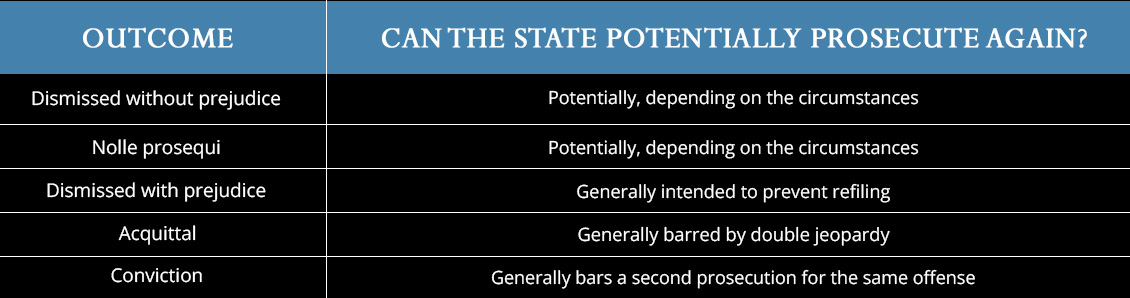
The exact procedural history is critical.
What About Double Jeopardy?
The Double Jeopardy Clause of the Fifth Amendment protects a person from being prosecuted twice for the same offense under circumstances where jeopardy has already attached.
But not every dismissal means that jeopardy has attached.
The question can become particularly complicated when a case is dismissed during or after certain stages of the proceedings.
For example, the consequences can differ depending on whether:
- A jury was sworn
- A bench trial began
- The case was dismissed before trial
- The defendant requested or consented to the dismissal
- The prosecution requested the dismissal
- The dismissal resulted from prosecutorial misconduct
- The dismissal was based on a procedural issue
Because of these distinctions, a criminal defense attorney may need to examine the entire procedural history before determining whether a subsequent prosecution is constitutionally prohibited.
Can Prosecutors Refile Charges After Dropping Them Before Trial?
Potentially, yes.
One situation that commonly causes confusion is when prosecutors decide not to move forward with a case before trial.
If the State enters a nolle prosequi, the original charging document is terminated. Florida courts have recognized that the State may, under appropriate circumstances, later file a new charging document.
However, prosecutors cannot simply ignore all other legal restrictions. The ability to refile can depend on:
- The reason for the dismissal
- Whether the dismissal was with or without prejudice
- Whether the statute of limitations remains open
- Whether speedy-trial rights were implicated
- Whether double jeopardy applies
- Whether the State's conduct violated the defendant's constitutional rights
Can a Dismissed Case Be Reopened Because New Evidence Appears?
Potentially, but the answer depends on how the original case ended.
If a case was dismissed without prejudice and prosecutors later obtain additional evidence, the State may potentially be able to file charges again if the law permits.
However,
new evidence does not automatically give prosecutors unlimited power to revive a criminal case. The State must still comply with applicable constitutional and statutory restrictions.
This is particularly important when the original dismissal was entered with prejudice or when the defendant has already been acquitted.
What Happens If the State Refiles a Dismissed Case?
If prosecutors file new charges after an earlier case was dismissed, the defendant should not assume that the new case is automatically valid.
A criminal defense attorney may examine whether the new prosecution should be challenged. Potential issues can include:
1. Statute of Limitations
Has the legal deadline for prosecution expired?
2. Double Jeopardy
Has the defendant already been placed in jeopardy for the same offense?
3. Speedy Trial
Did the circumstances surrounding the original and subsequent prosecutions create a speedy-trial violation?
4. Effect of the Original Dismissal
Was the original dismissal with prejudice or without prejudice?
5. Prosecutorial Conduct
Was the dismissal and subsequent refiling used improperly to avoid an unfavorable court ruling or otherwise prejudice the defendant?
6. Defects in the New Charging Document
Does the new indictment or information properly allege the offense?
These questions can determine whether the newly filed case can proceed.

Why the Reason for Dismissal Matters
Two people can both say, "My criminal case was dismissed," while having completely different legal situations. For example:
Person A: Their case was dismissed without prejudice.
Person B: Their case was dismissed with prejudice after a significant legal violation.
Person C: The State entered a nolle prosequi before trial.
Person D: A jury returned a not-guilty verdict.
All four cases ended in a way that might casually be described as "dismissed" or "over," but the legal consequences can be very different.
That is why an attorney should review the actual court disposition rather than relying solely on how the defendant remembers the case ending.
What Should You Do If You Learn Your Dismissed Case Has Been Refiled?
If you discover that criminal charges have been filed again after your previous case was dismissed, do not ignore the new case. You should:
1. Obtain the new charging document
Find out exactly what you are being accused of and which charges were filed.
2. Obtain the original case records
The original case may contain important information about why the charges were dismissed.
3. Get the dismissal order
The precise language can be extremely important.
4. Determine whether the dismissal was with or without prejudice
This may affect whether the State can legally pursue the case again.
5. Speak with a criminal defense attorney promptly
An attorney can compare the old and new cases and determine whether there are grounds to challenge the new prosecution.
6. Do not assume that silence means the case will disappear
A new prosecution can create court dates, deadlines, bond issues, and other legal obligations.
Can a Criminal Defense Attorney Get a Refiled Case Dismissed Again?
In some circumstances, yes. A defense attorney may identify legal grounds for filing a motion to dismiss the new case. Depending on the circumstances, possible arguments could involve:
- Double jeopardy
- Statute of limitations
- Speedy trial
- Improper refiling
- Defective charging documents
- Constitutional violations
- Prosecutorial misconduct
- Other procedural defects
Whether such a motion is appropriate depends entirely on the facts and procedural history of the case.
A dismissal of a previous case does not automatically guarantee dismissal of a later prosecution—but it can be highly relevant to the defense.
What If the Dismissed Case Still Appears on Your Criminal Record?
A dismissal and an expungement are not necessarily the same thing.
Even when criminal charges are dismissed, a criminal history record may continue to exist unless it is sealed or expunged under applicable law.
Florida law provides mechanisms for sealing and expunging certain criminal history records. In particular circumstances, a dismissed or nolle-prossed case may qualify for expungement if the statutory requirements are satisfied.
Florida also provides for automatic sealing of certain eligible criminal history records following dispositions such as dismissals, although eligibility requirements and exceptions apply.
Therefore, after a dismissal, it may be worthwhile to ask an attorney whether you qualify for record sealing or expungement.

How Donet, McMillan & Trontz, P.A. Can Help
At Donet, McMillan & Trontz, P.A., we understand that a dismissal can bring tremendous relief—but it can also create uncertainty when you learn that the State may be able to pursue the allegations again.
Our approach begins with understanding exactly what happened in the original case. We can review matters such as:
- The original charging documents
- The reason for dismissal
- Whether the dismissal was with or without prejudice
- Any nolle prosequi filed by the State
- Previous court orders
- The procedural history
- Potential statute-of-limitations issues
- Speedy-trial concerns
- Double-jeopardy considerations
- The new charging documents, if charges have been refiled
If the State has attempted to bring charges again, understanding the legal history of the original case may be critical to determining the strongest defense strategy.
A dismissed case may not always be the end of the story—but that does not mean the State automatically has the right to start the story over.
Frequently Asked Questions About Reopening Dismissed Cases in Florida
Can a dismissed criminal case be reopened in Florida?
Sometimes. A dismissed case may potentially be refiled depending on the type of dismissal, the reason for dismissal, the statute of limitations, and constitutional protections such as double jeopardy.
Can charges be refiled after a nolle prosequi?
Potentially. A nolle prosequi terminates the existing charging document, but Florida law may allow the State to formally refile charges in appropriate circumstances.
What does "dismissed without prejudice" mean?
Generally, it means the dismissal does not permanently prevent the State from bringing the charge again. However, other legal restrictions may still prevent refiling.
What does "dismissed with prejudice" mean?
Generally, a dismissal with prejudice is intended to prevent the State from prosecuting the same matter again. The specific order and circumstances should be reviewed by an attorney.
Can charges be refiled after an acquittal?
Generally, no. An acquittal triggers important double-jeopardy protections and bars a subsequent prosecution for the same offense in circumstances covered by those protections. Florida Statutes § 910.11 expressly addresses the bar created by an acquittal.
Can prosecutors refile charges after several years?
It depends. The applicable statute of limitations varies according to the offense, and Florida law contains numerous exceptions. Some serious offenses can be prosecuted without a standard limitation period.
Does a dismissed case disappear from my criminal record?
Not necessarily. A dismissal does not automatically mean every record associated with the case disappears. Depending on eligibility, sealing or expungement may be available.
Can a dismissed case be reopened if new evidence is discovered?
Potentially, if the original disposition allows further prosecution and the State remains within applicable legal limits. New evidence alone does not override constitutional protections or other restrictions.
What should I do if I am charged again after my case was dismissed?
Speak with a criminal defense attorney as soon as possible. Bring documentation from both the original case and the new case so the attorney can determine whether the new prosecution is legally permissible.
How do I know whether my case was dismissed with or without prejudice?
The best way is to review the actual court order or official disposition. Do not rely solely on a verbal explanation or the fact that the case no longer appears as pending.
Final Thoughts: A Dismissal Does Not Always Tell the Whole Story
Can a dismissed case be reopened?
The answer is: sometimes—but it depends on how and why the case was dismissed.
A dismissal without prejudice, a nolle prosequi, a dismissal with prejudice, and an acquittal can have very different consequences.
If criminal charges have been refiled after your case was dismissed, the first step should be determining exactly what happened in the original case and what legal authority the State is relying on to prosecute you again.
At Donet, McMillan & Trontz, P.A., our criminal defense attorneys can review the history of your case, explain your rights, and evaluate whether there are legal grounds to challenge a renewed prosecution.
If you have been charged again after a criminal case was dismissed, do not assume that the State's new case is automatically valid. Get the dismissal reviewed by an experienced criminal defense attorney.
Legal Disclaimer
This article is intended for general informational and educational purposes only and does not constitute legal advice. Florida criminal law can change, and the outcome of any case depends on its specific facts and procedural history. If you are facing criminal charges or a previously dismissed case has been refiled, consult with a qualified Florida criminal defense attorney about your individual circumstances.